 Get a Quote
Every supplier selling into Europe claims "CE certified". The mark itself tells you surprisingly little — it is a self-declaration, not a government-issued certificate, and its value depends entirely on the test reports sitting behind it. Here is what the CE mark on a luminaire actually covers, and the documents a serious buyer should demand.
No EU authority issues CE certificates. The manufacturer (or its authorized representative) assesses the product against the relevant EU legislation, draws up a Declaration of Conformity (DoC), and affixes the mark. The credibility comes from the technical file behind the DoC — and that is where suppliers differ enormously.
| Directive / Regulation | What it covers | Typical test standards |
|---|---|---|
| LVD — Low Voltage Directive 2014/35/EU | Electrical safety above 50 V AC: insulation, clearances, temperature rise, fire risk | EN 60598-1, EN 60598-2-x series |
| EMC — Electromagnetic Compatibility 2014/30/EU | The fixture must not disturb other equipment, and must withstand disturbance itself | EN 55015 (emissions), EN 61547 (immunity), EN 61000-3-2/-3 (harmonics, flicker) |
| RoHS — 2011/65/EU | Restriction of hazardous substances: lead, mercury, cadmium and friends in materials | IEC 62321 series (chemical analysis) |
| ErP — Ecodesign Regulation (EU) 2019/2020 + energy labelling (EU) 2019/2015 | Minimum efficacy, standby power, and the rescaled energy label for light sources | EN 13032, COMMISSION regulations |
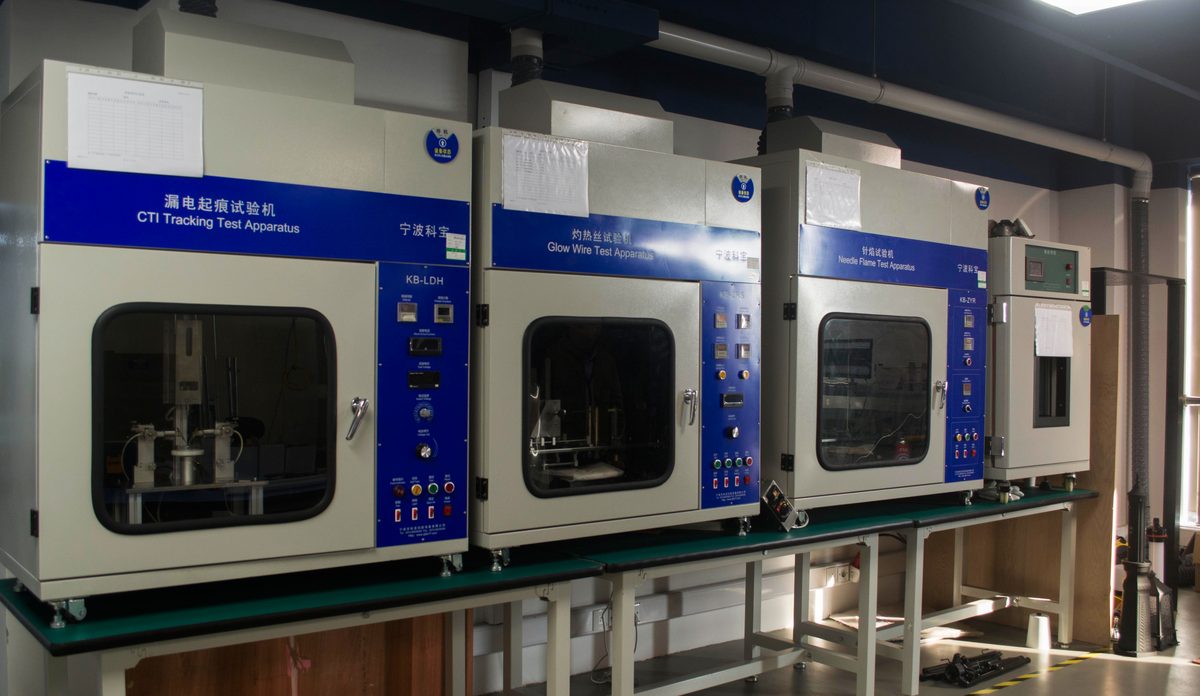
When we say our standard ranges are produced under CE (LVD + EMC), RoHS and ErP conformity, this is the set we mean — with test reports from our own lab and partner labs supplied per shipment. Representative reports are downloadable on our company page.
There is a known lookalike mark — same letters, different spacing — that means "China Export" and nothing else. Check the official CE proportions and spacing in the graphic itself.
Reports are series- and model-specific. A single generic "LED light CE certificate" covering everything from bulbs to high bays covers nothing.
Driver swaps change EMC and safety profiles. When we substitute a driver at your request (brand, dimming protocol), the substituted configuration is re-checked before shipment — ask any supplier whether theirs is.
Buyers who want third-party verification beyond self-declaration can specify ENEC, the European safety certification mark issued by testing houses. In our ranges, ENEC applies to driver options — we quote ENEC-certified driver configurations per model on request, confirmed at quotation stage.
CE plus the energy label is the baseline across the EEA. Some tenders or national schemes (French NF, German GS, public procurement lists) ask for more — we support per-tender documentation requirements.
No — the US market works on UL/ETL and FCC, a completely different system. If your project is US-bound, voltage, drivers and certification strategy are confirmed per model at quotation.
For a variant of an existing certified platform (new housing, new label), reports from an accredited lab typically land in 3–4 weeks. Plan this into private-label timelines.
DoC, test reports and photometrics assembled per shipment — ask for the document pack with your quotation.