 Get a Quote
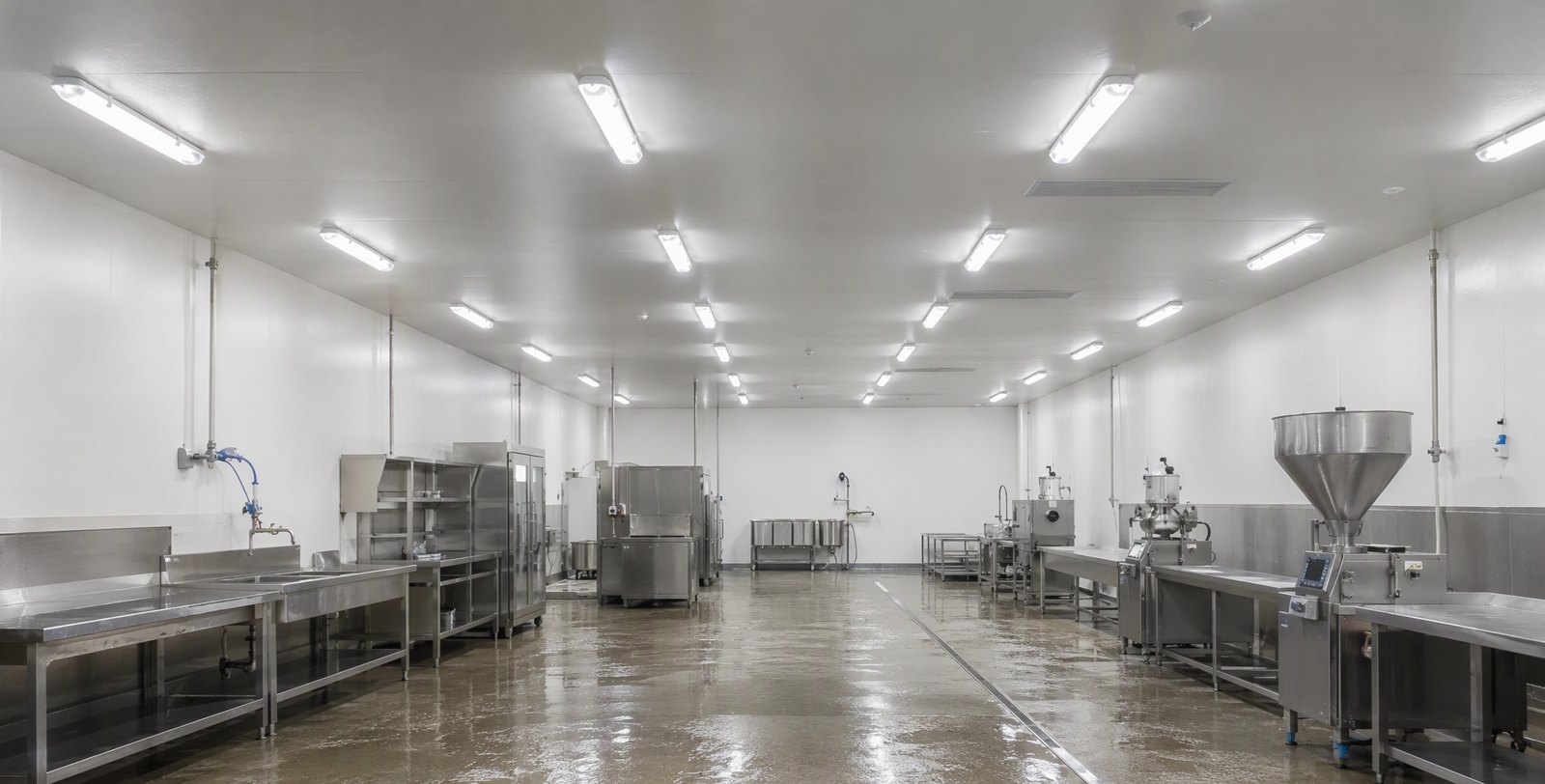
Every week, buyers send us spec sheets that ask for "IP65 minimum" on fixtures going into a food plant that gets hosed down twice a day. That light will fail within a year. On the other hand, specifying IP69K for a dry warehouse is money thrown away. Here is how to read IP ratings properly and match them to the job.
The IP code (IEC 60529) has two digits. The first digit rates protection against solids — dust and fingers/tools. A 6 means the enclosure is dust-tight, which is what you want for almost any industrial fixture. The second digit rates water — and this is where the money is:
| Rating | Water protection | Typical environment |
|---|---|---|
| IP65 | Low-pressure water jets from any direction | Warehouses, parking garages, workshops, general industry |
| IP66 | Powerful water jets (100 kPa-class nozzles) | Yards, canopies, exposed outdoor positions, dusty plants |
| IP67 / IP68 | Immersion resistance (temporary / continuous) | Underwater or flood-prone positions — rarely needed for ceiling fixtures |
| IP69K | High-pressure, high-temperature washdown jets (80–100 bar, up to 80°C) | Food, beverage, pharma and livestock — anywhere cleaning is aggressive |
The single most useful rule: the rating follows how the room is cleaned, not what the room is called. A dairy bottling hall and a parts warehouse are both "indoor", but the first sees 80-bar jet cleaning daily and the second sees a mop once a month.
No. IP69K tests high-pressure jets from close range; it says nothing about immersion. If a fixture can be submerged (floor-mounted lights in flood zones), you need a separate IP67/IP68 statement. For ceiling-mounted fixtures this rarely applies.
Impact is a different rating entirely — IK (EN 62262), from IK00 to IK10 (20-joule impact). Public areas, schools, mines and transport hubs often need IK08–IK10 on top of the IP rating.
The housing material drives cost more than the rating. A well-engineered PC housing reaches IP66 at a lower price than a poorly sealed metal one — which is why we validate seals with batch IP tests in our own lab rather than trusting paper claims.
Yes — most of our triproof families are offered in IP65, IP66 and IP69K variants on the same body, so maintenance teams keep one spare-part logic across the plant.
No — food-grade PC housings reach IP69K and resist most cleaning chemicals. Stainless (SS304/SS316) is specified when chemicals get aggressive, temperatures cycle hard, or the site demands metal for hygiene audits.
Ask for the IP test report per series — we supply reports from our in-house chambers with shipments, and per-model reports on request.
Send the room list or drawings — our engineers confirm the protection tier per zone, with reports.