 Get a Quote
"Lifetime: 50,000 hours" appears on virtually every LED datasheet, yet LEDs rarely fail by suddenly going dark. They fade. Understanding what the number really describes — and what it deliberately leaves out — is the difference between a fixture that serves a project for a decade and one that is visibly dim by year three.
Rated LED lifetime is a lumen maintenance figure, not a failure statistic. The industry standard endpoint is L70 — the time until output drops to 70% of initial lumens. Why 70%? Below roughly two-thirds to three-quarters of design output, a space no longer meets its original lighting design, and human perception starts noticing the deficit. So "50,000 hours" means: at 50,000 hours, this fixture should still deliver about 70% of its original light. It says nothing explicit about drivers, seals or electronics.
Other codes you may meet: L80/L90 (stricter maintenance targets, used in premium or long-warranty claims) and B10/B50 (the percentage of a population expected to have failed — B10 means 10% failures allowed). A serious lifetime claim states the full code: "L70B50 ≥ 50,000 h" reads very differently from a bare "50,000 h".
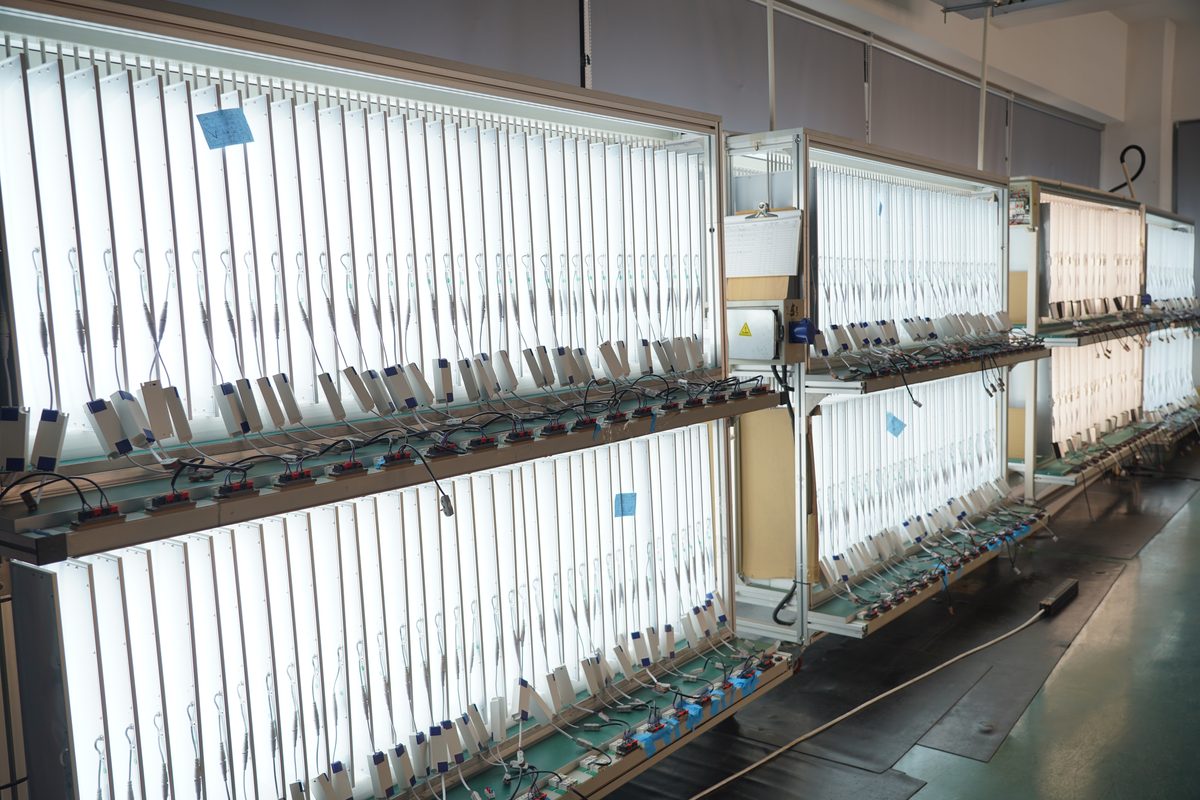
Nobody runs a luminaire for six years before selling it. Instead, the LED package itself is tested per IES LM-80: sample LEDs are burned at elevated temperatures (typically 55 °C, 85 °C and a third manufacturer-chosen point) for 6,000–10,000+ hours, with output measured at intervals. The raw data shows how the specific LED chip decays under thermal stress.
Two things matter for buyers. First, LM-80 tests the LED package, not your fixture — the same LED can live far longer or shorter depending on the fixture's thermal design. Second, ask whose LM-80 report it is: a branded-chip fixture cites the chip maker's report; a no-name LED often has none, and the lifetime figure is then a guess.
LM-80 only covers the first 6,000–10,000 hours. IES TM-21 is the mathematical model that extrapolates that data to longer horizons. Critically, TM-21 caps projections at six times the test duration: 6,000 hours of real data supports at most a 36,000-hour claim. So when a datasheet promises 100,000 hours, look for the LM-80 report behind it — if the burn lasted 10,000 hours, the maximum honest projection is 60,000.
In real fixtures, the most common end-of-life events are not LED fade at all:
A lifetime claim that only mentions LEDs is telling you half the story. For projects with a 5-year-plus service expectation, ask for the driver lifetime curve and the diffuser UV-stabilization data alongside the LM-80 summary.
No. Cleaning intervals, gasket inspection and driver health checks still apply — especially in dusty, humid or chemically aggressive spaces. Lifetime ratings assume reasonable maintenance and specified operating conditions.
Continuous operation burns ~8,760 h/year, so 50,000 hours of L70 covers roughly 5–6 years to the maintenance threshold. For 10-year horizons without relamping, specify L80/L90-grade platforms with premium drivers, and validate junction temperatures in your actual mounting conditions.
Not automatically. Warranty terms define what is covered (driver failure, water ingress, LED dead) and for how long. Lumen depreciation below L70 within warranty is only claimable if explicitly stated — ask us to align warranty wording with your project requirements.
We assemble the full lumen-maintenance documentation per model with your quotation.