 Get a Quote
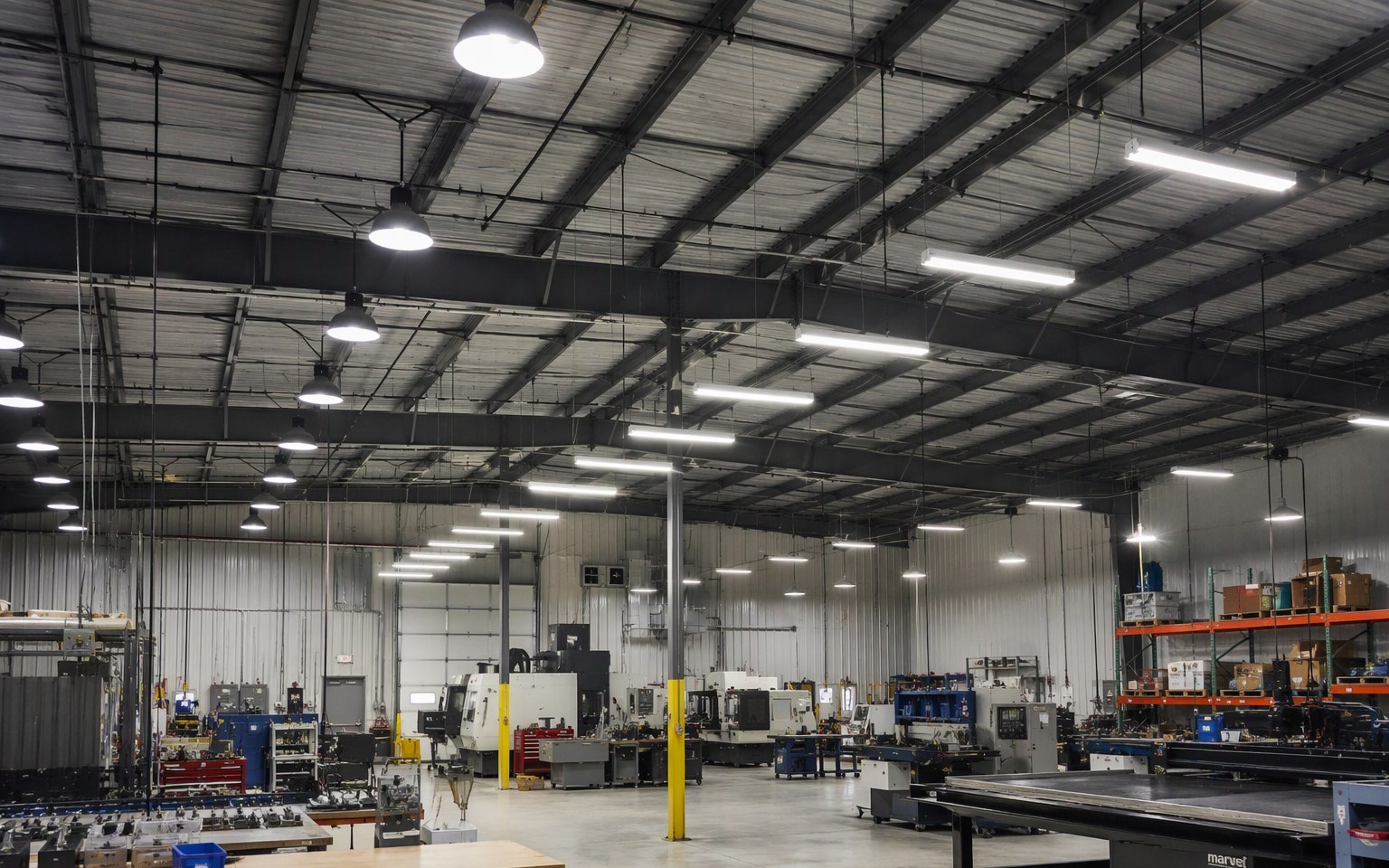
Round UFO high bays outsell linear high bays in export markets — partly on looks, partly on price. But facilities with tall racking, narrow aisles or long production lines often get dramatically better light from the linear format. The choice is not round-versus-rectangular aesthetics; it is beam geometry against your floor plan.
| Facility situation | Better choice | Why |
|---|---|---|
| Open workshop, no racks above ~6 m | UFO, 90° beam | Wide even pool, lowest cost per lumen, fastest install |
| Warehouse with racking over 6 m | Linear with aisle optic | Beam follows the aisle; vertical lux on rack faces instead of wasted light on rack tops |
| Very high ceiling (10 m+) | UFO, 60° narrow beam | Concentrates delivered lux at floor; wide beams wash walls at height |
| Production / assembly lines | Linear, continuous rows | Uniformity along the work plane, fewer shadows at benches |
| Gymnasiums, hangars, domed roofs | UFO, 120° | Wide throw covers irregular geometry; compact weight eases mounting |
| Cold storage / food plants | Either, IP65+ with low-temp driver | Format matters less than sealing and -25 °C component rating |
At 100–200 W in a compact UFO housing, thermal design separates a 50,000-hour fixture from a 20,000-hour one. Check three things on the datasheet: the LED junction-to-case thermal path (a full aluminum housing beats a stamped thin shell), the driver brand and rating (wide-voltage 100–240 V or 100–277 V for industrial sites with unstable grids), and the surge rating (4 kV minimum for industrial; 6–10 kV where lightning exposure or long feeder runs exist). For dusty or humid halls, IP65 with a conformal-coated driver board is the practical floor.
At 8–12 m mounting height, 100–150 W UFO units on 6–8 m grids typically deliver 200–300 lux at floor for general industry; warehousing with racks needs a Dialux run to balance horizontal lux against vertical illuminance on labels. If your supplier cannot return a Dialux calculation within a project quote, that is a service gap you will feel on every tender — we include it as standard.
Physically yes, photometrically no. Two 150 W UFOs rarely equal two 2×54 W battens in aisle uniformity. Recalculate spacing from the IES file rather than copying the old layout.
In markets with unstable industrial grids or where one SKU must serve 220–240 V and 277 V regions, yes — it also rides through voltage sags that kill narrow-range drivers early.
0–10 V dimming is standard on our industrial high bays; microwave motion sensors and daylight harvesting are available per SKU — useful for warehouses where 70% of operating hours have no aisle traffic.
Mounting height, racking height, target lux — send what you have and we will return a spacing layout with a Dialux calculation.