 Get a Quote
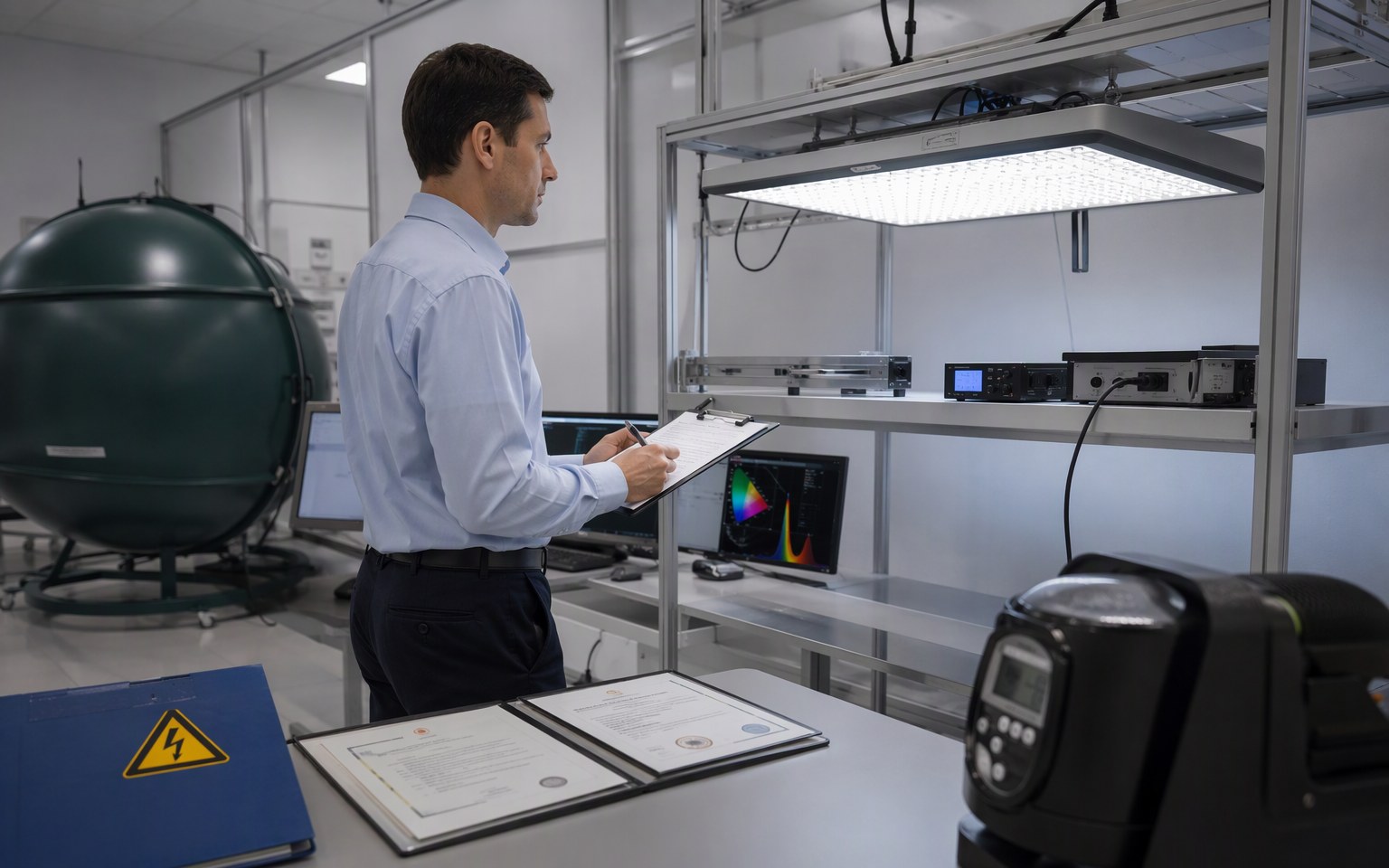
Three letters can decide whether your lighting shipment clears a European tender — or gets parked at customs while the buyer asks questions. CE, ENEC and TÜV travel together in sales conversations, but they are fundamentally different things: a legal self-declaration, a third-party certification mark, and a testing organization. Buyers who know the difference negotiate from strength.
The CE mark means the manufacturer declares conformity with EU legislation — for luminaires, chiefly the Low Voltage Directive (2014/35/EU), the EMC Directive (2014/30/EU), RoHS (2011/65/EU) and the ErP regulation (No 1194/2012) with its energy-label obligations. No government or notified body issues it. The manufacturer — or the importer, who shares legal responsibility — assesses the product, keeps a technical file, signs the Declaration of Conformity (DoC), and affixes the mark.
Two consequences follow. First, CE quality varies with the honesty of whoever signed — which is why "China Export" (a lookalike mark some factories print) is an old industry joke and a real customs risk. Second, the importer is legally exposed: if your company is the importer of record, EU market-surveillance authorities will ask you for the technical file, not the factory. Our CE documentation set — LVD and EMC test reports, DoC, ErP energy-class data — is built to be handed to your compliance file as-is.
ENEC (European Norms Electrical Certification) is the opposite model: product certification by an accredited third party under the ENEC agreement, with luminaires covered by the ENEC 303 scheme. The process includes type testing to harmonized EN standards (EN 60598 family), initial factory inspection, and — the part that separates it from a one-off test report — annual surveillance of both the factory and the market samples.
For a distributor, ENEC transfers risk: an independent body has verified the design, the production line, and continues to check. Many EU public tenders and retail chains list ENEC or an equivalent national mark as a requirement precisely because the liability chain is stronger than a self-declaration.
TÜV (SÜD, Rheinland, NORD) is a testing and certification organization, not a single mark. Three different things get casually called "TÜV":
When a supplier says "we have TÜV," ask which of the three. A test report plus CE self-declaration is common and legitimate; it is simply not the same as product certification with surveillance.
| Sales channel | What is typically required | What to prepare |
|---|---|---|
| EU retail distribution (private label) | CE + DoC + ErP energy label | LVD/EMC reports, technical file, label artwork |
| Public tenders, infrastructure, utilities | ENEC or GS preferred; CE as baseline | Certificate copy with number, valid-scope check |
| Nordic markets | ENEC accepted; some buyers ask for national marks | ENEC certificate usually sufficient |
| German-speaking markets | GS mark carries retail weight | GS certificate or ENEC as equivalent evidence |
| Customs / market surveillance audit | Full technical file on request | Test reports, DoC, risk assessment, labels |
One verification habit worth building: every ENEC and GS certificate carries a number — check it against the issuing body's online database before you sign a distribution agreement. It takes two minutes and catches photocopied certificates instantly.
Yes — CE is the legal baseline, and a proper self-declaration with full test evidence is legitimate. The risk is commercial and legal exposure: if the file is thin and market surveillance knocks, the importer carries the liability. ENEC moves that verification to a third party.
ENEC is accepted across the member countries of the scheme, which covers virtually all of the EU plus several neighboring markets. Some tenders phrase requirements as "ENEC or equivalent national certification" — ENEC satisfies that wording directly.
Three checks: the certificate number resolves in the issuer's public database; the certificate holder name matches the factory entity on the invoice; and the listed models match the model numbers on your purchase order. Mismatch on any of the three is a conversation worth having before shipment.
Partly by design: CE/RoHS/ErP are legal layers, ISO 9001 and BSCI are company-level systems, and ENEC/TÜV-mark are product-level certifications. For the EU market the stack reads as: legal baseline covered, factory systems audited, and product independently certified — the combination tenders ask for.
LVD and EMC reports, DoC, ErP data and ENEC certificates — request the complete document set for the models you import.