 Get a Quote
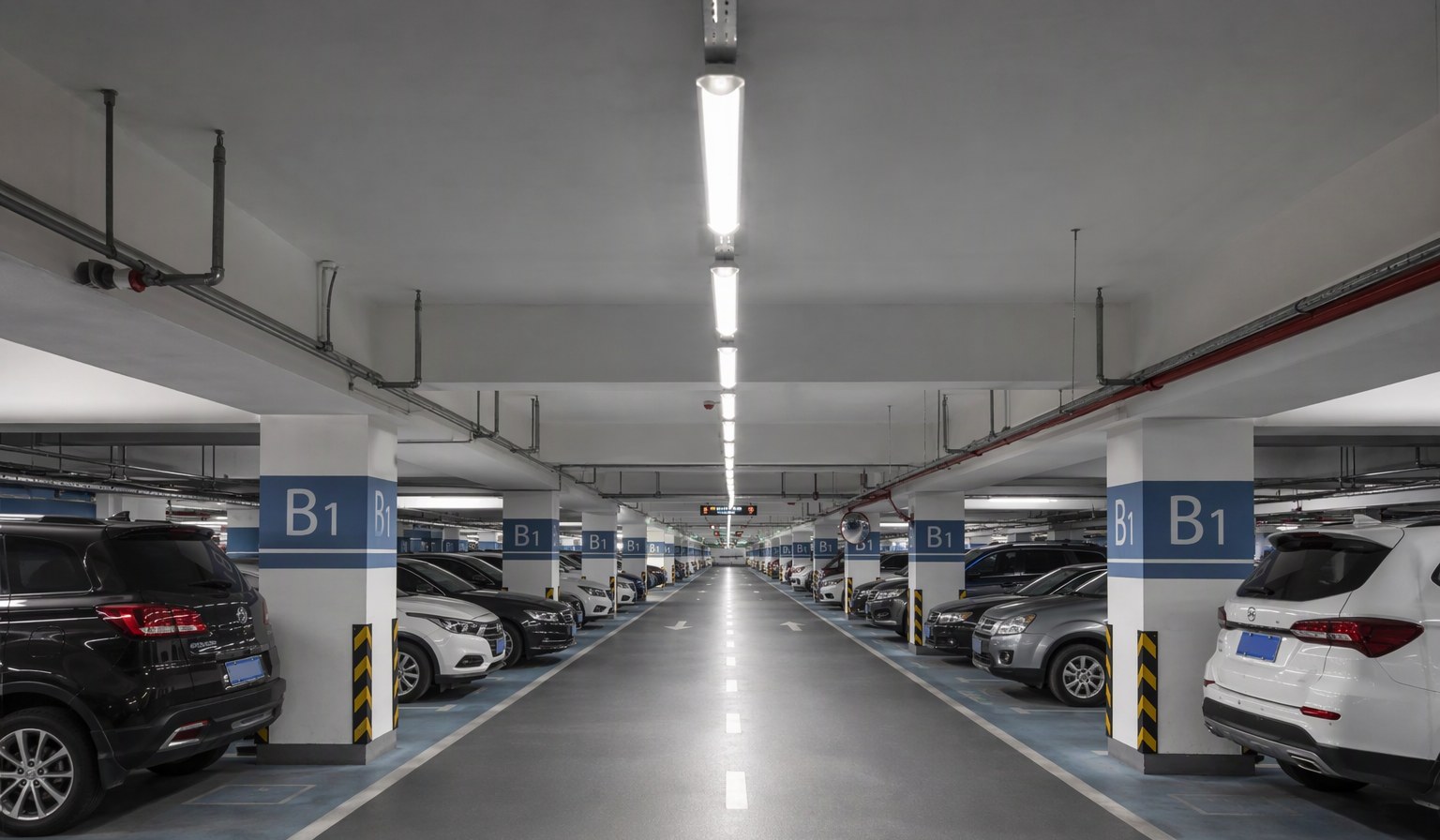
A parking garage, a logistics corridor, a row of cold-storage aisles: these spaces share one geometry — long, narrow and endless. Wiring them point-to-point, one junction box per fixture, is how contractors lose money. Linkable triproof lights exist to fix exactly this: the power feed enters the first fitting, and L/N/PE conductors run through the housing of every fixture in the row, so the whole line lights up from one supply point. Done right, it halves installation labor. Done wrong, it creates overloaded connectors and mysterious mid-run failures. This guide covers the standards and the math that separate the two outcomes.
Marketing catalogs use "linkable" loosely. Electrically, there are three distinct architectures, and a serious specification names one of them:
The specification line that matters: "5-pole through-wiring, 2.5 mm² conductors, terminal blocks rated 16 A." Anything less precise, and each supplier will quote a different interpretation. In Europe the product standard behind all of this is EN 60598 for the luminaire, with the internal wiring required to handle its rated current indefinitely at the fixture's maximum ambient temperature — a requirement budget fittings meet on paper and fail in a 40 °C ceiling void.
A note on terminology before the math: "maximum number of linkable fixtures" in a catalog is usually the mechanical connector rating, not a safe electrical design point. Treat catalog linking counts the way you treat a car's top speed — a limit to stay well under, not a target. The two real limits, load current and inrush current, come next.
A through-wired run is a single circuit, and its limit is set by three constraints working together: the breaker rating, the conductor cross-section, and the terminal block rating inside the fixture. In practice the fixture's terminal rating (typically 16 A) bites first. On a 220–240 V supply, the arithmetic is straightforward:
| Fixture wattage | Current per fixture (230 V) | Max fixtures on 16 A run* | Typical application at that count |
|---|---|---|---|
| 24 W (600 mm) | 0.10 A | 100 (cap at inrush, ~60) | Long corridors, livestock sheds |
| 36 W (1200 mm) | 0.16 A | 65 (cap at ~40) | Parking decks, warehouse aisles |
| 50 W (1500 mm) | 0.22 A | 47 (cap at ~30) | Cold stores, high-output aisles |
| 75 W (1800 mm) | 0.33 A | 31 (cap at ~20) | Industrial bays, processing halls |
*The asterisk is inrush current. LED drivers draw a sharp microsecond spike at switch-on, and circuit breakers see that spike, not the steady-state current. A B16 breaker feeding 65 drivers may nuisance-trip every morning at power-up. The conservative engineering rule is to stay at roughly 60 % of the arithmetic maximum, or specify C-characteristic breakers, or split the run with a contactor. Any supplier quoting run lengths without mentioning inrush is quoting a brochure, not an installation.
Two more cable rules: 2.5 mm² is the correct conductor size for 16 A through-wiring — some budget fittings ship 1.5 mm² looms that run hot at full load; and for runs longer than about 50 meters, check voltage drop (keep it under 3 %) rather than ampacity. On 100–277 V wide-voltage versions destined for industrial parks, the same wattage draws less current at 277 V, which buys you roughly 20 % more fixtures per run — a small but real advantage when retrofitting North-American-style three-phase sites.
Electrical linking is only half the job. A 40-fixture row looks professional only if every fitting sits at the same height and the gaps are consistent:
Suspension changes the alignment game. On chains or wires, each fixture finds its own level, so specify adjustable suspension kits and set the height with a laser line before energizing. Surface-mounted rows are faster but punish an uneven ceiling; check the substrate before committing the whole project to one mounting style.
Take a real example: a 60-meter parking aisle, 36 fixtures at 1200 mm. Point-to-point wiring means 36 junction boxes, 36 gland entries and roughly 25 minutes of electrician time per fixture — about 15 labor hours. Through-wiring means one feed point, tool-free terminal connections, and roughly 10 minutes per fixture — about 6 labor hours. At European electrician rates, that difference is several hundred euros per aisle, every aisle, before you count the junction boxes and cable saved.
Linking also changes maintenance math. A through-wired row with a 5-pole loom can carry a switched emergency or dimming pair alongside the mains conductors, so mixing sensor versions and emergency versions into the run needs no extra cable. One run, three fixture behaviors — standard, microwave-sensor, 3-hour emergency — all from a single feed. That is the configuration that wins parking and corridor tenders, and it is why our linkable triproof series is built around a 5-pole loom rather than the cheaper 3-pole alternative.
There are honest limits. Linking pays on straight or gently branching geometry; it pays nothing in a scattered layout where fixtures cluster around columns and machines. Retrofit jobs with existing conduit also favor point wiring, since the conduit paths are already bought. And where tenants or zones need separate metering, one feed per run works against you — each tenant then needs their own linked run or their own junction boxes. Match the architecture to the building, not to the catalog. When you request quotes, send the floor plan with the run lengths marked; a factory that builds these systems daily will return a run-splitting proposal with the fixture schedule, which is a faster way to compare suppliers than any unit price list.
The arithmetic limit on a 16 A, 220–240 V circuit is roughly 100 fixtures at 24 W down to 31 at 75 W — but inrush current at switch-on is the real constraint. Engineer the run at about 60 % of the arithmetic maximum (or use C-characteristic breakers), and check voltage drop on runs longer than 50 meters. Our team will calculate the exact run layout from your fixture wattage and breaker type.
Yes — that is precisely what the 5-pole through-wiring loom is for. The three mains poles (L/N/PE) feed the standard and sensor fittings, while the two extra poles carry a permanent live for emergency versions or a dimming/switching line. Mixing behaviors in one run requires no additional cable, only the correct fixture variants in the correct positions.
No — through-wired variants are tested and certified as complete products under CE/ENEC like any other fixture, and they carry the same 3–5 year warranty as the rest of our triproof range. The certification point that matters is the terminal block and conductor rating (16 A, 2.5 mm²); ask for the test report section covering the through-wiring loom if your tender requires documented evidence.
Send us your corridor or aisle layout — we return fixture counts, run splits and breaker sizing, with wiring diagrams your contractor can build from.