 Get a Quote
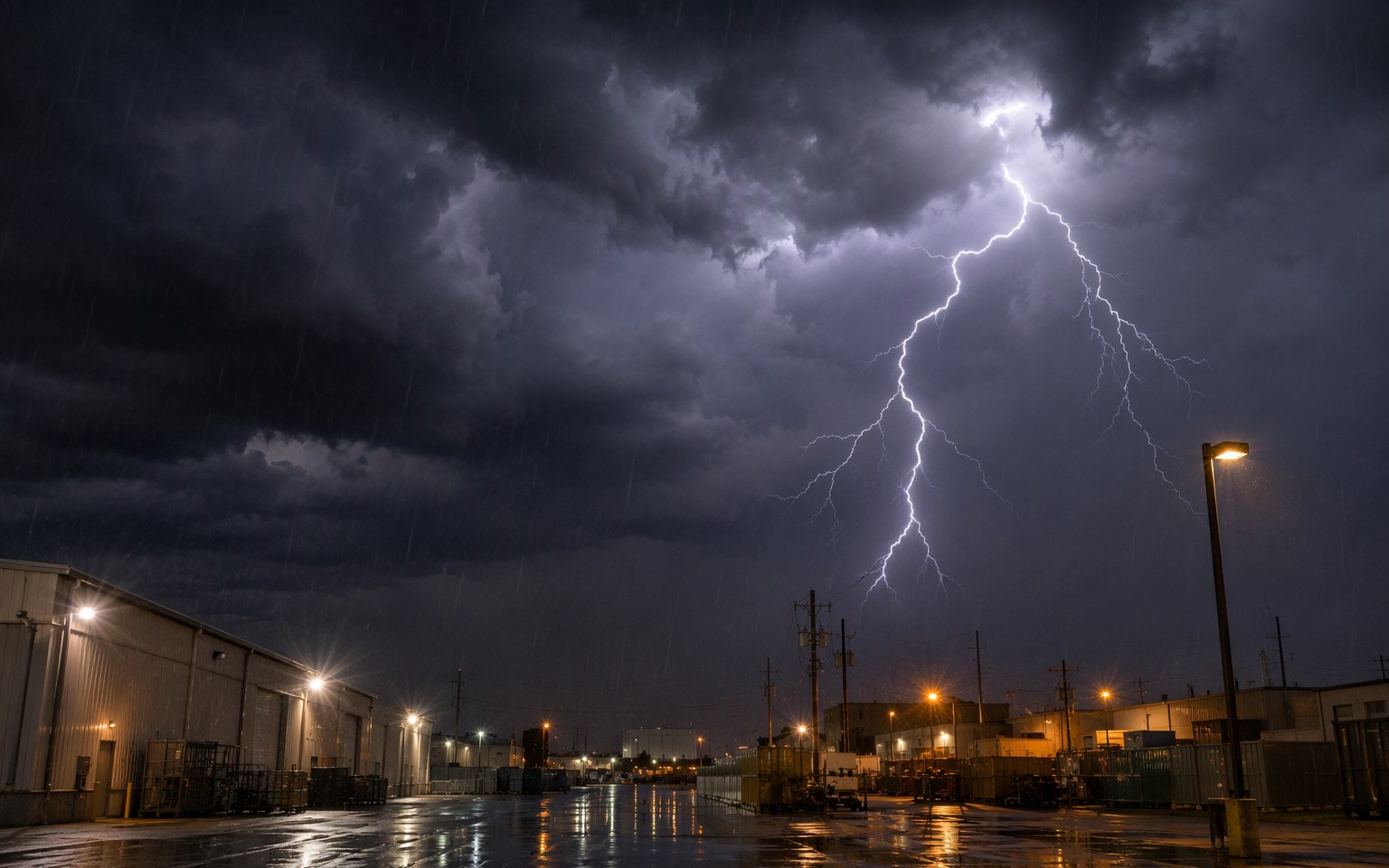
Every storm season, the same warranty pattern arrives: a batch of outdoor LED fixtures — fine for a year — dies in the same week across several sites. The housings are intact, the LEDs test good, and the drivers are charcoal. The cause is almost never the lightning strike itself; it is the surge the strike pushes into the power line. Here is what that surge does, and how to specify protection that actually works.
A surge is a brief overvoltage spike — microseconds long, thousands of volts high. Two sources matter for outdoor lighting:
Test labs reproduce these with standardized waveforms (the 1.2/50 μs voltage + 8/20 μs current combination of IEC 61000-4-5), applied in two modes: differential mode (line-to-line, L–N) and common mode (line-to-earth, L–PE / N–PE). A fixture can pass one mode and fail the other — which is why "20 kV surge protected" on a carton means almost nothing without mode details.
Inside the driver, protection is typically a MOV (metal-oxide varistor) for differential mode, sometimes paired with a gas discharge tube for common mode. MOVs degrade a little with every event — a driver that survives ten small surges may fail the eleventh even without a storm.
A magnetic-ballast HID luminaire shrugged off most surges; the winding insulation was robust and the lamp itself indifferent to voltage ripple. An LED driver's switch-mode front end is the opposite: small high-voltage capacitors, fast semiconductors, and a control IC sitting millimeters from the input terminals. The efficiency gain came with a fragility gain. Good drivers compensate with properly sized MOVs and creepage distances; cheap drivers bolt on one undersized MOV and print "surge protected" on the box.
| Installation environment | Minimum spec to write | Rationale |
|---|---|---|
| Urban indoor / well-screened networks | 2 kV differential, 2 kV common (IEC 61000-4-5 level 3) | Switching surges dominate; distant from exposed lines |
| General outdoor: yards, gardens, building perimeters | 4 kV differential, 6 kV common | Induced surges from nearby strikes on distribution lines |
| Rural feeders, poles, exposed sites, high lightning density | 6 kV differential, 10 kV common minimum — 10/20 kV preferred | Long overhead lines collect surge energy; earth potential rise matters |
| Critical infrastructure: ports, airports, solar farms | 10/20 kV + external Type 1/2 SPD per pole | Downtime cost dwarfs the SPD cost |
And two contractual points that prevent disputes:
A protected driver costs 5–10% more than an unprotected equivalent; efficiency impact is under 0.5%. Against one field-failure truck roll, the math is not close.
The three usual suspects: the rating covered only one test mode, the earthing at the pole was poor, or the MOVs had silently degraded through years of small surges. Test reports, grounding inspection and replaceable SPD modules each address one of these.
For critical or high-exposure sites, yes — an external Type 1 or Type 2 SPD (IEC 61643-11) at the distribution point protects the whole circuit and is replaceable after a major event. Built-in protection is the right floor for standard outdoor fixtures.
It should. We state surge immunity per mode on datasheets and honor driver warranties accordingly — ask any supplier to write the same linkage into their terms before you compare prices.
Send the failed fixture model and site layout — our engineers will review surge path, earthing and driver protection level.