 Get a Quote
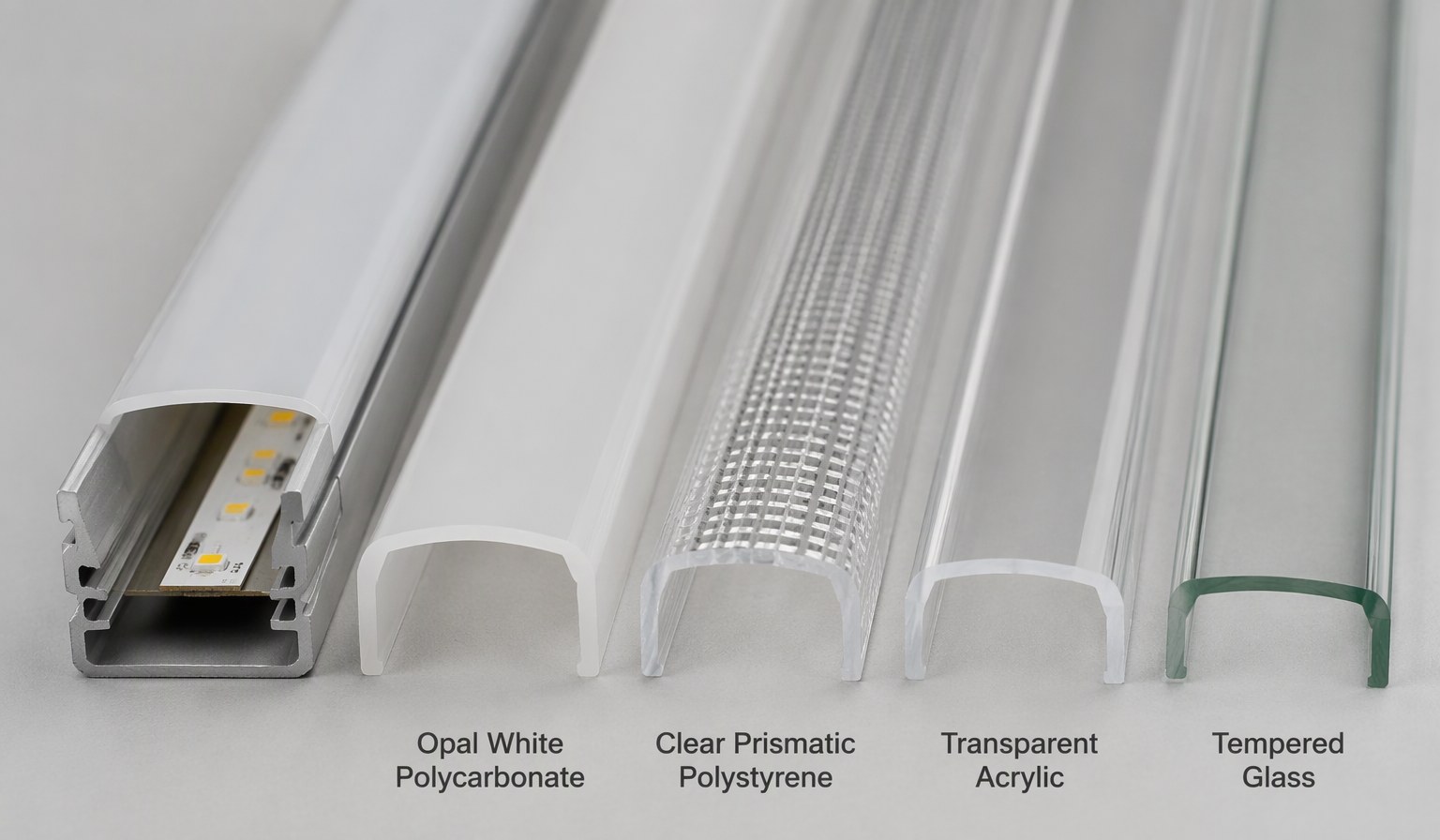
Ask a buyer what a triproof light is made of and most will say "plastic." Ask the factory and you get a three-part answer: a housing, a diffuser and a clip set — and the diffuser alone can be polycarbonate, PS, PMMA or tempered glass. The choice decides how much light reaches the floor, whether the cover survives a forklift strike, and what the fixture looks like after three summers of UV. This guide compares the four materials on the properties that actually fail in the field.
A diffuser is not just a cover. It does three jobs at once, and every material trades them differently:
Keep the three jobs in mind when reading quotes, because suppliers optimize different ones. A fixture engineered for optics sacrifices impact strength; one engineered for IK10 gives up some transmission. There is no cheat code — only an honest allocation of trade-offs. The sections below make those trade-offs concrete.
Polycarbonate (PC) is the industry default for good reason. Its impact strength is roughly 200 times that of glass and 30 times that of standard acrylic, which is why virtually every IK08–IK10 rated triproof fixture uses a PC diffuser. It handles continuous service up to about 115 °C, and flexible enough to be extruded in long profiles — important for 1500 mm and 1800 mm fixtures where a rigid cover would crack at the clips.
PC's weakness is UV. Raw polycarbonate yellows and turns brittle under sunlight, so outdoor-facing PC diffusers need a co-extruded UV-resistant cap layer. Always ask whether the UV protection is co-extruded (permanent) or spray-coated (wears off). Chemical resistance is middling: PC survives dilute cleaning agents but crazes on contact with some solvents and strong alkalis — a real concern in washdown food plants, where IP69K washdown duty and aggressive detergents coincide.
Transmission runs 85–90 % in opal form, higher in clear prismatic versions. If a project specifies both high impact and high output, the answer is usually a clear prismatic PC diffuser with a wide batwing distribution. The trade between the two forms is worth understanding: opal diffusers hide the LED points completely and forgive dust on the lamp surface, but cost up to ten points of transmission; prismatic clear diffusers pass more light and shape it optically, but show hotspots and demand a tidier LED layout inside. For parking garages and industrial ceilings, prismatic PC is usually the better engineering answer; for spaces where people look directly at the fitting, opal keeps visual comfort.
Polystyrene (PS) is the budget option, and it behaves like one. It offers excellent light transmission — up to 92 % — and extrudes into crisp prismatic patterns, which is why it appears in cost-driven indoor fixtures and fluorescent-era diffusers. But PS is brittle (IK04–IK06 at best), degrades fast under UV, and softens around 80 °C. In a sealed fixture above a hot driver, a PS diffuser can warp visibly within two years. We recommend PS only for climate-controlled indoor commercial sites where impact and heat are non-issues — and we say so on the quote.
PMMA (acrylic) sits a class above: similar clarity to PS (up to 92 % transmission), far better UV resistance — it is the standard material for outdoor signage precisely because it barely yellows — and better heat tolerance around 90 °C. Its weakness is the opposite of PC's: acrylic is hard and scratch-resistant but cracks under sharp impact, typically reaching only IK06–IK07. PMMA diffusers make sense for high-mounted fixtures, canopies and outdoor-rated fittings where sun exposure is the main aging force and nothing will physically hit the lamp.
Watch for one substitution in the budget market: diffusers sold as "acrylic" that are actually PS/PMMA blends or regrind material. Blends inherit the worst of both — PS's brittleness with mediocre clarity — and regrind yellows unpredictably because the polymer history is unknown. The tell is price and datasheet vagueness: a supplier who cannot state the exact resin grade ("PMMA, virgin optical grade") is telling you something. The same logic applies to PC, where regrind material quietly turns an IK10 fixture into an IK06 one.
Tempered (toughened) glass is the specialist's choice. It is chemically inert — resistant to solvents, strong detergents, oils and salt — optically stable forever, and indifferent to heat up to 250 °C. In food and pharma washdown lines, chemical plants and high-temperature process areas, glass outlasts every polymer. It also cannot yellow, haze or craze, which keeps measured lumen output stable across the fixture's whole life.
The trade-offs are weight, impact behavior and cost. Even tempered glass fails at lower impact energies than PC — it shatters safely into granules rather than cracking, but it still fails, and a broken cover ends the IP seal until replaced. Glass also cannot be extruded into clip-in profiles, so fixtures need a frame-and-gasket design, which adds assembly cost. In practice, glass diffusers belong to stainless steel fixtures aimed at the corrosive end of the market, not to volume PC triproofs.
One more material note that surprises first-time buyers: the gasket matters as much as the cover. A silicone gasket survives heat cycling and stays elastic for a decade; a cheap EPDM or PVC gasket takes a compression set within a few years and the IP rating quietly dies while the fixture still looks fine. When a supplier quotes an unusually low price on an IP66 fixture, the gasket and the clips are usually where the money came out. Ask for the gasket material by name, and specify stainless clips on any humid site.
| Property | PC (polycarbonate) | PS | PMMA (acrylic) | Tempered glass |
|---|---|---|---|---|
| Light transmission (opal/prismatic) | 85–90 % | 88–92 % | 88–92 % | 90–91 % (clear) |
| Impact resistance (typical IK) | IK08–IK10 | IK04–IK06 | IK06–IK07 | IK06–IK08 |
| UV / yellowing resistance | Needs co-extruded UV layer | Poor | Excellent | Total (does not degrade) |
| Continuous heat limit | ~115 °C | ~80 °C | ~90 °C | ~250 °C |
| Chemical resistance | Moderate; crazes on solvents/alkalis | Poor–moderate | Moderate–good | Excellent (inert) |
| Relative cost | Baseline | Lowest | +10–20 % | +30–60 % |
| Best-fit sites | Warehouses, parking, sports halls, anything at impact height | Indoor commercial, cost-driven retrofits | Canopies, high-mounted outdoor-rated fittings | Food/pharma washdown, chemical plants, high-temp process areas |
One rule of thumb closes most decisions: if something can hit the fixture, specify PC and put the IK rating in the tender; if the sun or the chemicals are the enemy, specify PMMA or glass; and if the site is a conditioned indoor space, PS is the honest budget answer — as long as nobody on the project pretends otherwise.
And when in doubt, ask for a sample of each material and abuse it: freeze it, strike it, wipe it with the site's actual cleaning agent. A diffuser sample costs a supplier almost nothing to send; the answers it gives are worth more than any datasheet line. We ship material samples with every triproof quotation for exactly this reason. Test reports support the choice too: a credible supplier can produce the UV-aging and impact test data behind each IK and weathering claim, not just the claim itself.
Only unprotected PC yellows. A co-extruded UV-resistant cap layer — not a spray coating — blocks the wavelengths that break down the polymer, and modern capped PC diffusers hold their color for years outdoors. When you source outdoor-facing fixtures, ask specifically whether UV protection is co-extruded into the profile; that one question filters out most quality problems in advance.
In practice, no. Tempered glass covers typically certify to IK06–IK08 depending on thickness and frame design; the repeatable IK10 impact energy (20 joules) is polycarbonate territory. If a site needs both IK10 and aggressive chemical or heat resistance, the usual engineering answer is a thick PC diffuser with a stainless housing, or relocating the fixture out of impact range — both options our engineers can model for your layout.
From a manufacturer, yes — this is one of the real differences between buying from a factory and buying from a trader. We keep diffuser tooling and clip sets for discontinued series, so a broken cover in year four is a spare-parts shipment, not a full re-lamping project. Ask any supplier to commit to spare-diffuser availability in writing; it is a cheap promise that reveals a lot about who actually makes the product.
Tell us the site — impact risk, chemicals, sun exposure — and our engineers will specify the diffuser material and IK rating for your project.