 Get a Quote
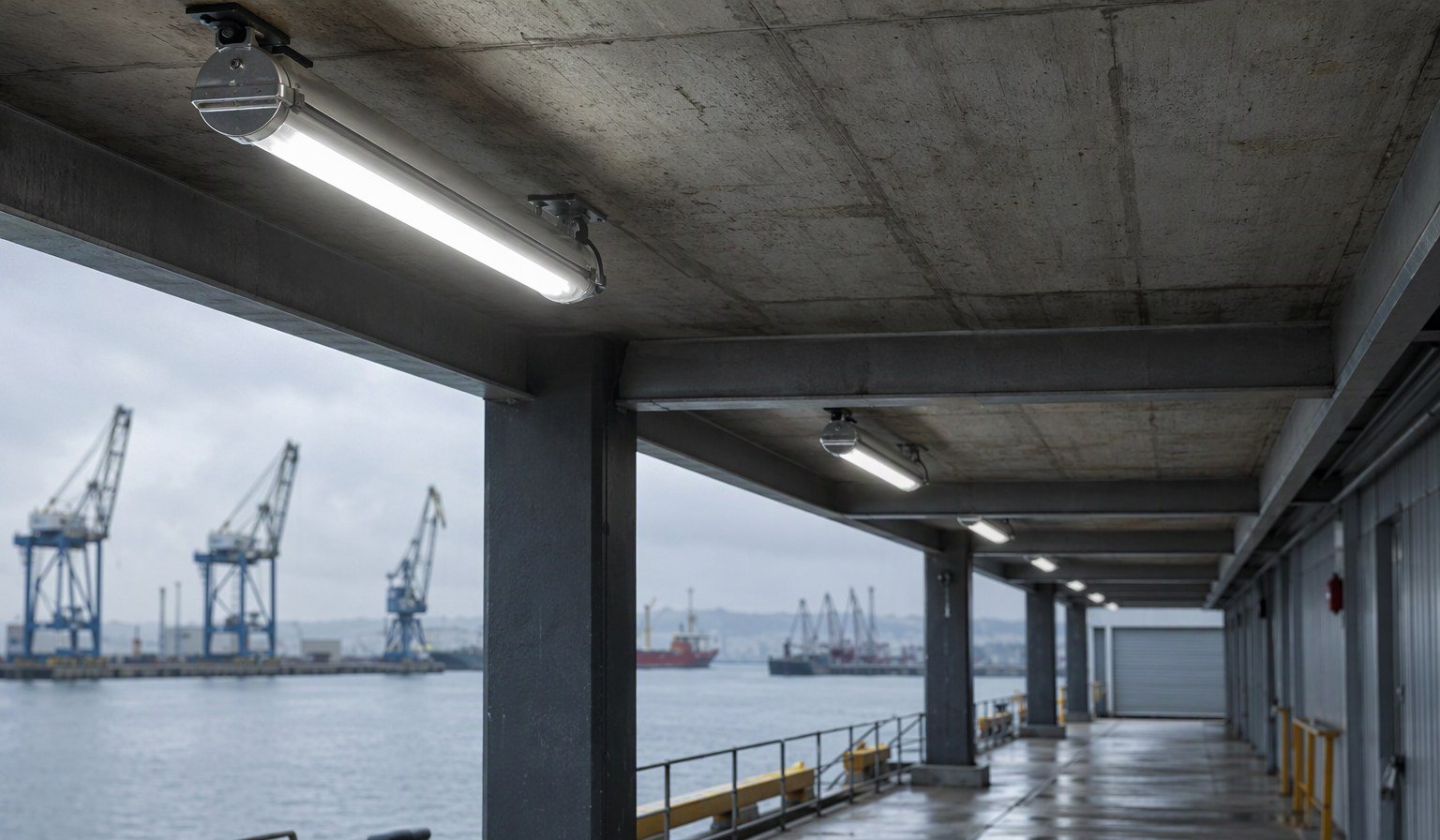
Twenty kilometers inland, a standard powder-coated fixture lives a normal life. Five hundred meters from the surf, the same fixture shows red rust at the screws inside eighteen months, white powder on the housing seams inside three years, and a dead driver soon after. Coastal and marine projects fail lighting faster than any other environment we ship to — not because the fixtures are badly made, but because they were specified for a generic "outdoor" duty that does not exist. This guide is how we specify corrosion-proof lighting for ports, harbors, coastal warehouses, offshore-adjacent plants and shipyards — and the evidence you should demand from any supplier, including us.
Salt does not attack a fixture in one place; it attacks it in four, simultaneously:
Salt also travels. Airborne salinity drops with distance from the shoreline, but "coastal" is not a binary condition — prevailing winds push chloride aerosols several kilometers inland, and a site 2 km from the sea in the wind path can corrode like a seafront. Before you specify anything, establish where the project sits on the corrosion map, not just on the road map.
The professional shortcut is the ISO 12944 / EN ISO 9223 corrosivity scale. It converts "near the sea" into a category a coating system and material choice can be engineered against:
| Category | Typical site | What survives there |
|---|---|---|
| C3 (medium) | Coastal towns, sites 5–20 km inland with moderate salt deposition | Quality powder-coated aluminum, PC housings with stainless (A2) hardware |
| C4 | Industrial coastal areas, port perimeters, chemical plants, 1–5 km band | Marine-grade coated aluminum or 304 stainless, A2/A4 fasteners, verified coating system |
| C5-M (very high, marine) | Seafronts, jetties, shipyards, offshore platforms, splash zones | 316L stainless or GRP, A4 fasteners, C5-M rated coating system on any aluminum parts |
Two practical notes on the table. First, most catalog "outdoor" fixtures are engineered and tested to C3 at best — installing them at C5-M is how the eighteen-month rust story begins. Second, the category applies to every component, not just the housing: a 316L body held together with A2 screws is an A2 system. Our 304 vs 316 stainless comparison covers the grade chemistry in detail; the short version is that molybdenum-alloyed 316/316L resists chloride pitting where 304 eventually fails, and it is the correct default inside the C5-M band.
For genuinely coastal work, the material shortlist is short:
Galvanic corrosion deserves its own sentence, because it is the most-missed coastal failure: dissimilar metals in contact — a stainless fixture on a galvanized bracket, an aluminum housing on a steel frame — form a battery in salt film, and the less noble metal sacrifices itself. Specify isolation washers or matching metals at every interface, and flag the bracket material on the order, not just the luminaire material.
A coastal-proof luminaire is a set of documented decisions, and each one has a spec line you can copy into a tender:
Even a correctly specified fixture can be installed into an early grave. The coastal rules our project teams insist on:
None of this is exotic. It is the difference between treating "marine" as a marketing adjective and treating it as an engineering category with a test standard, a material grade and a maintenance plan. Send us the site — distance from shore, wind exposure, washdown regime — and the specification comes back with the category named, the materials matched and the test evidence attached.
Inside the C3 band — coastal towns and sites several kilometers inland — yes, with A2 fasteners and a sensible maintenance regime. In the C4 band it is a judgment call that depends on wind exposure and chloride deposition. At C5-M (seafronts, jetties, splash zones), no: chloride pitting and crevice corrosion will find 304, and 316L with A4 hardware is the correct specification. Distance from the surf is the first question to answer, not the last.
ISO 9227 neutral salt spray is an accelerated comparison test, not a lifespan simulator — 1,000 test hours do not literally equal a number of years at sea. What it proves is that the coating system, hardware and sealing survive concentrated chloride exposure without blistering, red rust or seal failure, which lets you rank suppliers on evidence. Ask for the post-test photos and the test lab's report number, not a checkbox on a datasheet.
Not meaningfully. You can swap screws for A4 stainless and add a drip loop, but the housing material, coating system, gasket compound and driver protection were fixed at the factory. Marine duty is a design decision, not a retrofit — if the site is genuinely C4 or above, specify the fixture for it at purchase and keep the standard fixtures for inland work.
Send us the site conditions — distance from shore, wind, washdown regime — and we return a material, coating and hardware specification with the test evidence attached.