 Get a Quote
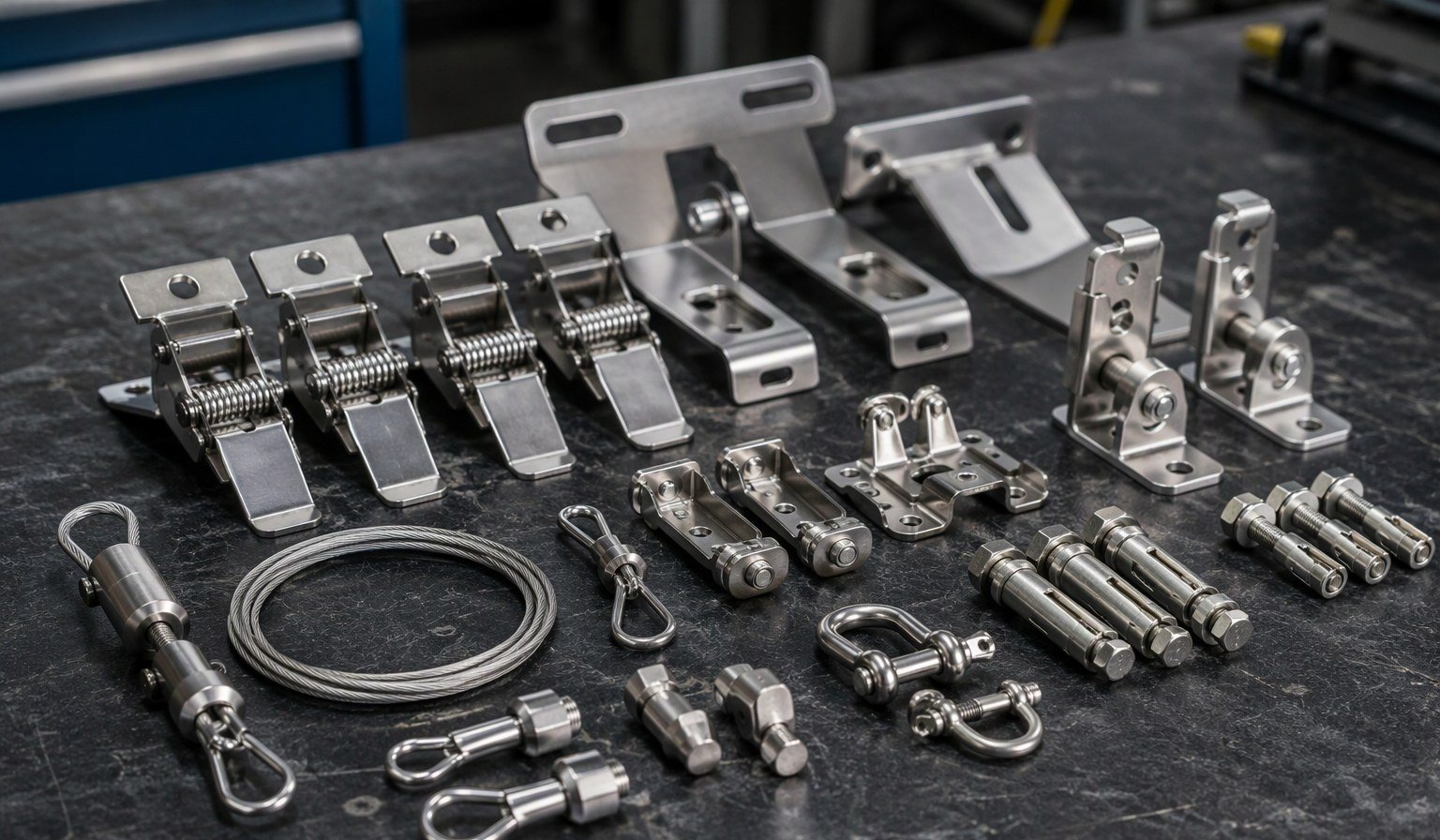
Luminaires rarely fail because the housing breaks. They fail — or fall — because a €0.10 clip crept, an anchor pulled out of soft concrete, a wire gripper loosened under vibration, or a wall bracket met its first real storm. The fixture gets the warranty claim; the mounting hardware caused the funeral. This guide walks the three mounting families used for industrial and commercial LED lighting — surface, suspended and wall/pole — through the components that fail first, and the specification lines that keep them boring for a decade.
Surface mounting — clips or brackets screwed directly to ceiling or wall — is the default for triproofs, battens and panels on solid ceilings. It is also where the most silent failures accumulate:
One more surface-mount detail that separates professional kits from commodity ones: clip spacing tolerance. A fixture whose clips must hit an exact pitch forces the installer to drill precisely every time; clips with a few millimeters of sliding adjustment forgive real-world marking and make one-person installation possible on a ladder.
High bays, linears and panel grids hang — on steel wire kits, chains or threaded rod. Suspension moves the failure point from the substrate to the connectors, and adds a new enemy: motion.
Hook-mounted UFO high bays simplify much of this — one rated eyebolt into a structure, one safety cable, done — which is part of why the format dominates open-floor halls; our UFO vs linear comparison covers where each format earns its place. Linear fixtures on two-point suspension demand more leveling discipline: set heights with a laser, not by counting chain links, and re-check after the first week as cables seat.
Wall packs, flood lights and brackets live outdoors, cantilevered, and the force that designs their hardware is wind — a load many buyers never mention in an RFQ:
| Mounting | Weakest component | Typical failure | Specification that prevents it |
|---|---|---|---|
| Surface (clips/anchors) | Anchor in substrate; clip material | Anchor pull-out in weak masonry; clip corrosion and sag | Substrate stated in spec; anchor type per substrate; stainless clips (A2/A4) |
| Suspended (wire/chain) | Gripper lock; open hooks | Vibration creep; unhooking under sway | Rated grippers with 5× SWL; closed hooks or shackles; independent safety cable |
| Wall / pole (brackets) | Top anchors under pull-out; metal interfaces | Wind-load withdrawal; galvanic corrosion at bracket | EPA + wind zone in RFQ; chemical anchors/through-bolts; isolation washers |
| All | Cable glands and entries | Water tracking along cable into housing | Bottom entry, drip loops, gland size matched to cable OD |
Five lines in an RFQ eliminate most mounting failures before a single fixture ships. State the substrate (concrete grade, steel deck, block, timber). State the environment for the hardware (interior dry, humid, washdown, coastal — the clip and fastener grade follows). State the motion (vibration sources, sway, wind zone for anything outdoors). Require stainless fasteners and a safety retention method for suspended loads. And ask for the installation manual with the quotation — a supplier whose manual shows torque values, anchor types and wiring entry diagrams has installed their own product before.
Logistics follow from the same thinking. Mounting kits are usually optional SKUs with their own MOQs — standard clips ship with the fixture; suspension kits, wall brackets and pole adapters are ordered per project, and mixing them up holds containers at customs of the schedule kind: the fixtures arrive, the brackets do not. And spares are cheap insurance: two percent extra clips, grippers and gaskets in the first order turns future maintenance from a freight shipment into a walk to the store room. Hardware is the least expensive line on a lighting order and the most expensive one to get wrong — specify it with the same care as the lumens.
Standard surface clips ship with triproof and batten fixtures by default. Suspension wire kits, chains, wall brackets and pole adapters are optional SKUs with their own MOQs — list them explicitly on the purchase order with quantities, and order roughly two percent extra clips and grippers as site spares. Confirming the kit list before production is far cheaper than air-freighting forgotten brackets.
Whenever fixtures hang over people, production lines or goods — which in practice means almost every warehouse, retail hall, sports venue and public building, and most professional tender specifications now state secondary retention explicitly. Even where local rules are silent, the cost of an independent steel safety cable is trivial against the liability of a falling fixture, so we recommend specifying it everywhere.
Often, with verification. Check anchor condition and substrate integrity, confirm the new fixture's weight and clip pitch against the old holes, and replace every zinc-plated fastener you disturb with stainless. Reusing points saves real labor on large retrofits, but a fifteen-year-old anchor in a humid car park is a reused failure — when in doubt, drill new holes and seal the old ones.
Send your mounting plan — substrates, heights, wind exposure — and we will return the fixture schedule with every clip, bracket and safety cable itemized.