 Get a Quote
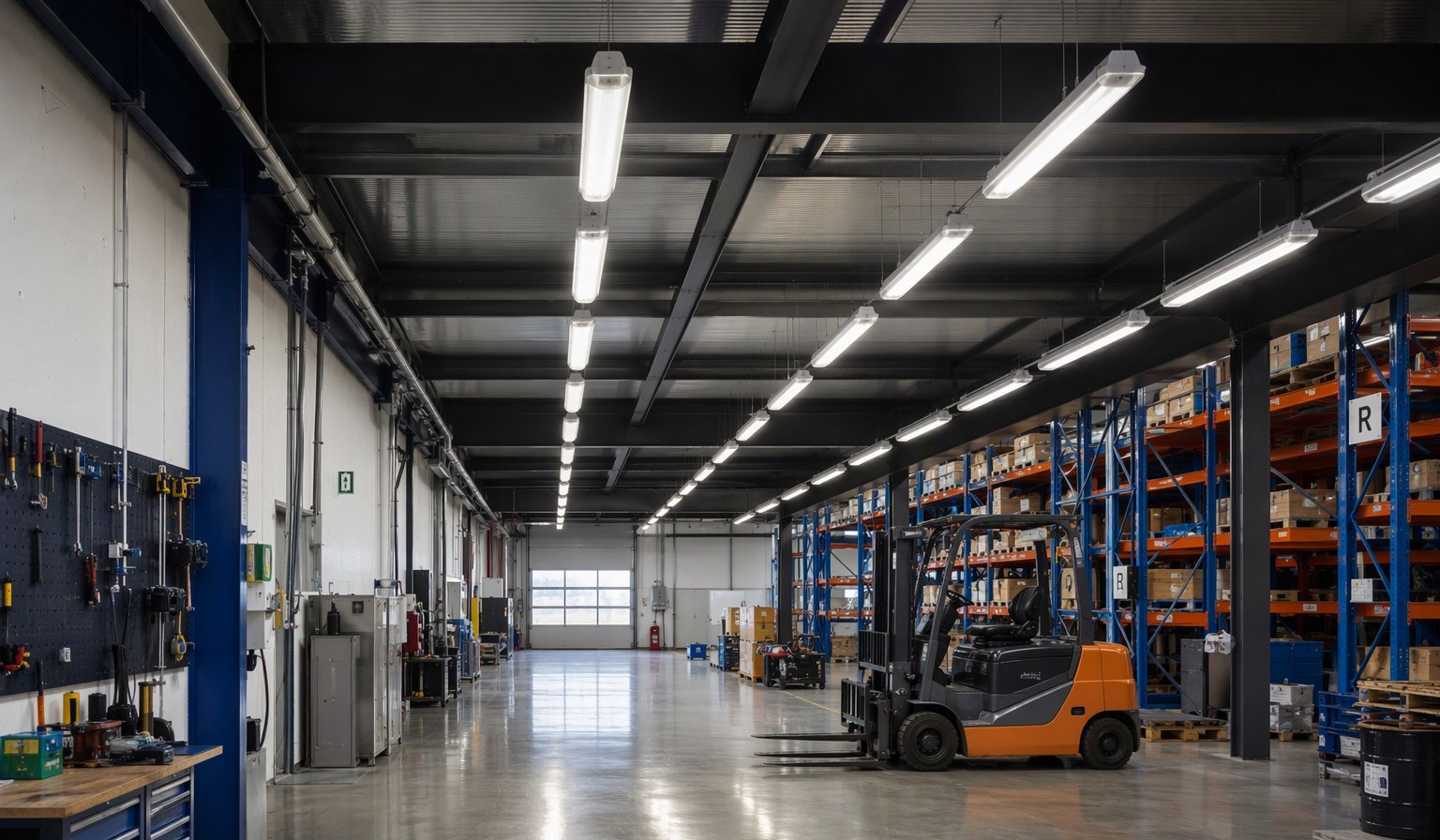
Every week a purchase order arrives in our inbox that says little more than "triproof light, 1200 mm, 500 pcs." Every week we send back the same reply: a list of twelve questions. The buyers who answer them get a fixture that installs without surprises and passes inspection the first time. The ones who don't get containers of almost-right product. This checklist is those twelve questions, organized the way our engineers read them — so you can write a triproof specification once and reuse it for every supplier, including us.
"Triproof" covers dust, moisture and corrosion — but each site weights the three differently, and the housing material follows from that weighting, not the other way around. Before you compare a single datasheet, write down four facts about the installation:
While you are documenting the environment, record the lighting target too. "Warehouse aisle, 200 lux at floor, uniformity 0.4" is a specification; "bright enough" is an argument waiting to happen. If you do not know the target, the standards are public: 100 lux for storage and parking circulation, 200 lux for warehouses and loading bays, 300 lux for packing and inspection-adjacent work, 500 lux for fine assembly. Send the target with the inquiry and a competent factory will return fixture counts, not just fixture prices.
Triproof fixtures ship in four standard lengths, and each length has a sane wattage band. Specifying outside the band either wastes money or starts a thermal compromise:
| Length | Sane wattage band | Typical output | Replaces |
|---|---|---|---|
| 600 mm (2 ft) | 18–24 W | 2,300–3,100 lm | 1×36 W or 2×18 W fluorescent |
| 1200 mm (4 ft) | 30–45 W | 3,900–5,900 lm | 1×58 W or 2×36 W fluorescent |
| 1500 mm (5 ft) | 45–65 W | 5,900–8,500 lm | 2×58 W fluorescent, high-output zones |
| 1800/2400 mm (6/8 ft) | 65–100 W | 8,500–13,000 lm | Industrial bays, cold stores |
On top of the band, three electrical lines belong in every spec:
The fixture price is decided at the factory; the project cost is decided on the ladder. Two spec lines control most of the labor:
One small line that prevents big arguments: pre-wired leads. A fixture shipped with 30 cm of factory-fitted cable and a sealed connector installs in minutes; a fixture that opens for wiring on a ladder takes four times as long and introduces a sealing error every time someone over-tightens a gland. Decide per project which you want, and write it on the PO — both are legitimate, but they are different SKUs.
Three option families account for nearly all quote-to-quote variance between suppliers. Decide them before you ask for pricing, or you will compare quotes for different products:
Export packaging deserves one spec line too. Fixtures going into distributor stock need individual printed cartons with barcode labels; project deliveries ship better in bulk outer cartons with dividers. Sea freight adds a month of vibration and humidity — ask for a drop-test standard (ISTA 1A is the common baseline) and desiccant in every carton. None of this costs much; all of it is painful to retrofit at the destination warehouse.
Finally, the paperwork: state the warranty term in the order (3–5 years is the professional range for industrial fixtures), ask for LM-80/TM-21 lifetime data to support the L70 claim, and list the certificates you need with the quote request — CE/ENEC/RoHS for the EU, with test reports, not just declarations. A supplier who sends the full file set in the first email saves you a week per order.
They are the same product category under two regional names — "triproof" is common in Europe and Asia, "vapor tight" in North America. Both describe a sealed linear luminaire with an IP65-or-better rating protecting against dust, moisture and corrosion. When sourcing, compare datasheets by IP/IK rating, lumen output and driver quality rather than by name.
For a single-market EU order, 220–240 V is sufficient and slightly cheaper. If you distribute across regions, supply industrial sites with three-phase-derived 277 V feeds, or sell into markets with unstable grids, the 100–277 V wide-range driver is worth the small premium — one SKU then covers every market. It must be ordered as such; the voltage window is set by the driver hardware.
Three to five years is the professional standard for industrial LED fixtures, backed by LM-80 and TM-21 lifetime data on the LED package. Anything offered without supporting test data is a marketing number, not a warranty. Also clarify the claim logistics — who pays freight on replacements, and whether replacements ship as whole fittings or kits.
Bid-stage specification reviews are free — wattage, voltage, wiring and options checked against your site conditions within 24 hours.